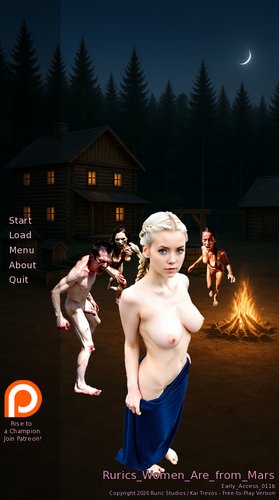





Ruric's Women Are from Mars

| Package ID: | |
|---|---|
| Latest Version: | v1775066975 |
| Latest update: | Jul 29, 2026 17:12:02 |
| Developer: | ruricstudios |
| Requirements: | Android |
| Category: | Casual |
| Size: | 379.19 MB |
| Tags: | Drive Management Strategy |
Rating :4.1
Ruric's Women Are from Mars is an adult-themed cinematic strategy novel that places you in the perspective of Ruric as you lead a small household inside a failing Mars biodome, balancing survival, leadership, and difficult moral choices. This editor introduction outlines the core systems and player experience: branching narrative scenes that interleave with practical management, tactical encounters that emphasize preparation and relationships, and ritual-driven social mechanics that shape long-term consequences. The tone is deliberately sober and story-first, aimed at players who appreciate slow-burning tension and decisions that matter.
Overview
Ruric's Women Are from Mars situates its drama within a confined, generational community where dwindling supplies and established customs influence every decision. The game alternates between cinematic sequences that reveal character motivations and interactive planning phases where you allocate food, labor, and influence across a household. Encounters can be resolved through negotiation, tactical confrontation, or compromise that carries social cost, and choices ripple across chapters, changing how non-player characters react and which narrative paths remain available. The result is a compact, consequential storyline that rewards careful consideration over impulse.
Gameplay and Mechanics
Gameplay pairs choice-driven narrative with light but meaningful strategic systems. During narrative beats you make dialogue and leadership choices that affect reputation, trust, and access to options later in the story. Between scenes you manage household duties: assign roles, repair infrastructure, ration supplies, and plan scavenging runs. Combat is resolved as tactical, story-weighted encounters that depend on preparation, team composition, and prior decisions rather than twitch reflexes. Ritual and social mechanics create obligations and opportunities, so maintaining relationships can unlock unique problem-solving approaches while neglecting them can impose severe penalties.
Controls and User Experience
Controls are optimized for touch devices and designed for clarity. Dialogue and scene choices use tap-to-select interactions, while household management relies on menu-driven assignment and drag-like selection metaphors adapted for mobile. Contextual prompts appear before high-stakes choices to outline likely consequences, and informative tooltips explain the immediate mechanical impact of major decisions. Menus emphasize readable resource balances, reputation indicators, and current assignments so players can plan without feeling overwhelmed. The pacing favors thoughtful decision making, allowing players to pause and reflect rather than react under time pressure.
Progression and Structure
Progression unfolds across discrete chapters that function like episodes in a serialized novel. Each chapter introduces new constraints, characters, and events that force players to re-evaluate strategy and social priorities. Advancement is driven by surviving pivotal incidents, securing resources, and building or preserving alliances that enable new options. Branching narrative paths and permanent consequences create multiple routes to late-game scenarios; some strategies emphasize consolidation and stability, while others trade immediate gains for risky long-term advantages.
Visual Style and Level Design
The visual approach emphasizes cinematic framing and a moody palette that matches the confined, deteriorating biodome environment. Close-up character moments carry emotional weight during story scenes, while planning screens use schematic, easy-to-read layouts to show household structure and nearby territories. Level design favors compact areas with layered challenges: contested supply caches, ritual locations that influence social dynamics, and narrow corridors that shape tactical decisions. Audio and visual cues communicate urgency and threat without relying on constant action, allowing atmosphere to drive tension.
Customization, Replay Value, and Replayability
Customization focuses on household composition, leadership priorities, and ritual choices rather than cosmetic items. Who you choose to elevate, which traditions you preserve or abandon, and which alliances you pursue all meaningfully change mid- and late-game options. Multiple branching outcomes, character-driven consequences, and alternative strategies create strong replay value: different leadership philosophies reveal new scenes, tactics, and endings, encouraging several full playthroughs to explore alternate storylines and approaches.
Accessibility, Offline Play, and Challenge Systems
The game supports offline play and saves progress automatically between chapters so you can pause and return without losing narrative context. Accessibility options include adjustable text size, high-contrast display modes, and difficulty settings that alter resource scarcity and event frequency to suit varied player preferences. Challenge systems emphasize resource scarcity, social obligations, and time-sensitive events that reward planning and adaptability rather than reflex skill. Overall, Ruric's Women Are from Mars aims to deliver a measured survival strategy experience with narrative depth, clear controls, and systems that support multiple leadership styles and long-term thinking.