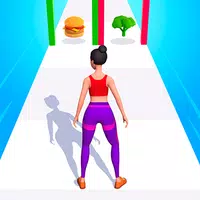

Twerk is a hybrid running game that blends fast-paced 3D obstacle courses with a playful body-changing mechanic and end-of-level dance showdowns. In Twerk you sprint down colorful, short-form tracks, collect different foods to bulk up or slim down, and adapt your size and timing to clear hazards while racing toward the finish. Each stage finishes with a lighthearted twerk battle where body stats, timing and style influence the final result, creating a compact session loop that is easy to pick up and return to between other tasks.
Gameplay and mechanics
The core of Twerk is a run-and-react rhythm: players move along lanes, make quick item choices, and respond to dynamic obstacles. Foods placed on the track change your avatar's silhouette and movement properties — heavier pickups increase momentum and can smash through certain barriers, while lighter choices improve jump control and agility for fragile platforms. Obstacles include breakable glass, sliding ramps and narrow passages that require you to plan when to bulk up or slim down. The twerk battle at the end of each run transfers your accumulated stats and positioning into a timing-based showdown that turns the run into a short, entertaining finale.
Controls and accessibility
Controls are designed for simple, one-handed mobile play: intuitive taps and swipes are used to switch lanes and trigger short bursts of speed or jumps. For devices with motion sensors you can optionally enable tilt steering to feel more connected to movement, while control sensitivity is adjustable in settings to suit different playstyles. Sound and music levels are customizable, motion effects can be reduced for comfort, and color-friendly palettes are available to improve visibility for a wider range of players. These options aim to make the game approachable without sacrificing the quick, arcade-like pace.
Progression and upgrades
Progression in Twerk is driven by short runs that reward in-game currency based on distance, obstacle clears and twerk-battle performance. Earnings can be spent in a simple gym-building system to upgrade equipment that modifies future runs, such as lighter shoes for better jumps or strengthening gear that changes how collisions behave. Cosmetic unlocks — outfits, shoes, and accessories like heels — let players personalize their runner and appear in the end-of-level showdowns. The upgrade path is intentionally straightforward so casual players can see tangible progression without long grind cycles.
Level structure and challenge
Levels are designed as compact stages that take a few minutes each, making them suitable for short sessions. Early stages introduce the basic size-shifting choices and simple obstacles; later levels mix those elements into more complex sequences and tighter timing windows. Optional secondary goals and hidden routes encourage replay: aim for cleaner runs, seek alternate lanes with higher rewards, or try to finish with a specific body state to unlock certain challenges. Difficulty ramps gradually, so players can learn mechanics before facing tighter platforming or heavier obstacle clusters.
Visual style and presentation
The game favors a colorful, humorous presentation to keep tone light and accessible. Character models and environments use bold shapes and bright palettes to make state changes clear at a glance, while animations emphasize playful movement rather than realism. The end-of-level dance showdowns use exaggerated, stylized choreography and stage lighting to create a comedic competitive moment rather than a realistic depiction, maintaining a family-friendly, cartoonish feel throughout.
Customization and replay value
Customization focuses on visual variety and small gameplay tweaks through equipment. Outfit choices and accessory combinations offer cosmetic goals to pursue, while incremental upgrades in the gym provide meaningful but modest changes to how runs play out. Replay value comes from mastering level layouts, experimenting with different food strategies, improving twerk-battle timing, and refining upgrades to suit preferred approaches. Short stage length and clear progress markers encourage repeated attempts without long commitment.
User experience and offline play
Twerk is built for single-player, offline-friendly play so runs are available without an internet connection. Local leaderboards and in-game scoring let you compare best runs on your device, and the interface keeps menus and progression clear so new players can jump in quickly. Regular sessions feel rewarding because of short runs, straightforward rewards and visible improvements from upgrades, making the game a convenient pick-up-and-play option for casual audiences.