
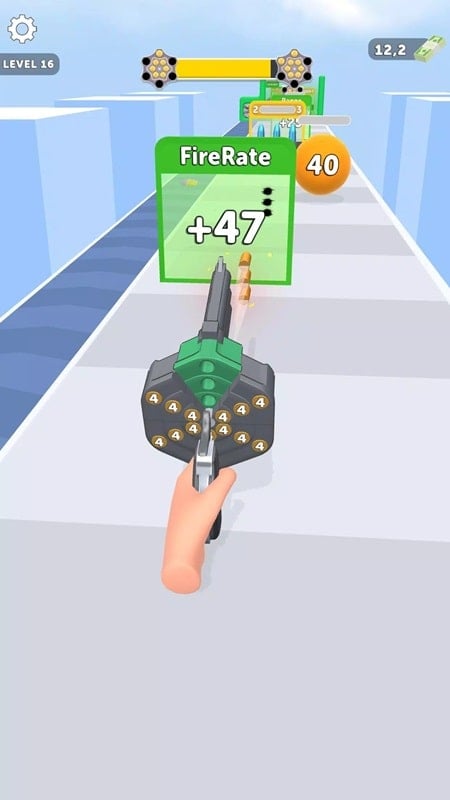
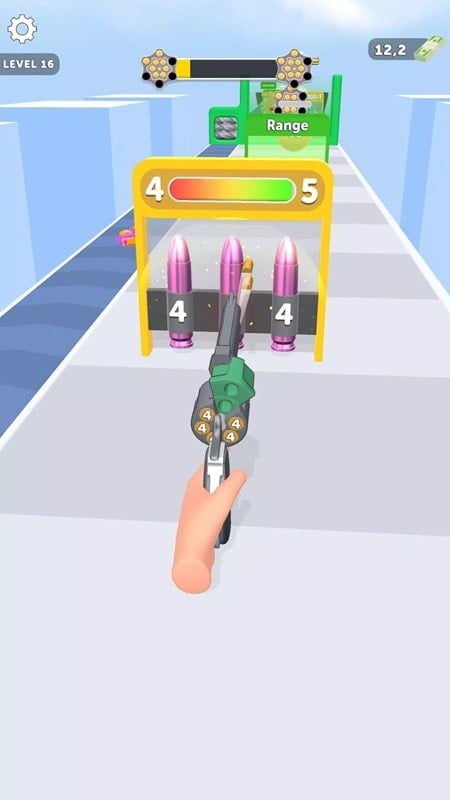
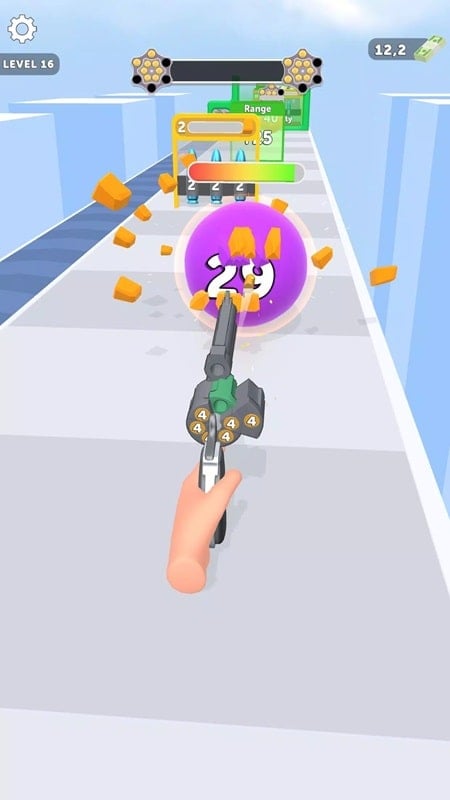

Revolver Rush is an action arcade shooter game for Android that tests aim, timing and decision-making in short, intense rounds. In Revolver Rush players manage a six-shot pistol while a teleportation gate alternates between sending ammunition and sending obstacles toward the play area, forcing quick choices between collecting shells and taking precise shots. The description below focuses on gameplay mechanics, progression, controls and design so reviewers and players understand the app type and the experience it delivers.
Gameplay mechanics
The core loop centers on a unique teleport gate that alternates spawning shells and barriers. Players must time shots to break incoming obstacles without wasting limited ammo, and collect shells when the gate produces ammunition to keep the revolver loaded. Damage management matters because each shot counts: upgrades increase bullet damage and change how many hits are required to clear tougher barriers. The alternation of spawn types creates a rhythm where prediction, reflexes and spatial awareness all play a role. Levels favor compact encounters that encourage repeated attempts and incremental improvement rather than long, drawn-out missions.
Controls and input
Revolver Rush uses simple, responsive touch controls designed for mobile screens so players can focus on aiming and timing. The control scheme emphasizes direct aiming input and quick shot execution rather than complex gestures, making it accessible to new players while still rewarding steady hands and practice. Input responsiveness and clear visual feedback ensure that targeting and positioning feel intuitive, allowing short practice sessions to translate into measurable skill gains.
Progression and upgrades
Progression in Revolver Rush is straightforward and transparent. Players improve their performance by unlocking upgrades that increase bullet damage, expand ammo capacity beyond the initial six-shot revolver and refine accuracy. Upgrade choices shape playstyle: investing in damage shortens encounters, while capacity and accuracy upgrades reduce the pressure of tight sequences. Progression is paced so early runs teach basic mechanics and later levels require more deliberate upgrade planning to overcome escalating challenges.
Level structure and challenge systems
Levels are intentionally bite-sized and ramp in complexity, making Revolver Rush suitable for short sessions or focused practice. Early stages introduce the teleport gate rhythm and basic obstacles, while later levels speed up gate cycles and present more intricate obstacle patterns. Challenge systems rely on pattern recognition and timing rather than random difficulty spikes; players face increasingly varied combinations of obstacle types and spawn timings that reward memorization and split-second decisions.
Visual style and audio cues
The visual design emphasizes clarity so bullets, shells and obstacles remain easy to read during frenetic moments. High-contrast shapes and simple particle effects keep the action legible on a range of screen sizes, while minimal visual clutter preserves focus on aiming and positioning. Audio cues provide additional timing information; clear impact and reload sounds help players judge successful hits and anticipate the next gate cycle, supporting both novice and experienced players.
Customization and player choice
Customization in Revolver Rush comes through the upgrade path and how players allocate improvements between damage, capacity and accuracy. These meaningful choices let each run feel distinct without overwhelming players with menus or options. Because the game emphasizes skill, upgrades amplify player proficiency rather than replace it, and this balance maintains a satisfying sense of mastery as runs grow more difficult.
Replay value and user experience
Replay value is built into the short-run structure and the clear progression loop. Players who enjoy improving aim and minimizing mistakes will find repeated attempts rewarding, as small gains in accuracy lead to noticeably longer runs and smoother clearances. The interface keeps information visible and unobtrusive so players can concentrate on timing and targeting, and the overall pacing supports both casual pick-up sessions and focused practice.
Accessibility and offline suitability
The design of Revolver Rush favors accessible interactions and concise play sessions, making it well suited to mobile use during brief breaks. Control simplicity lowers the barrier to entry, and the compact level design reduces session commitment. The game is optimized for on-device play, so players can enjoy short runs without relying on persistent online connections, which helps when playing in offline or low-connectivity situations.
What to expect
Expect a compact, skill-focused shooter that emphasizes timing, resource management and precision. Revolver Rush challenges players to balance collecting shells with taking aimed shots, to choose upgrades that complement their approach and to learn patterns through practice. The result is a tight arcade experience that rewards steady improvement and quick reflexes without requiring extended play sessions.