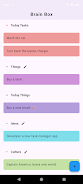
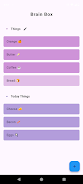
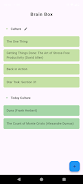

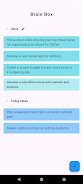

Brain Box is a lightweight note-capture app designed to help you record discoveries, ideas and recommendations the moment they occur. Brain Box puts a simple recording surface in front of you so you can jot down a movie tip, a question about a new topic, a product you’re considering, or an insight that popped up during a meeting or on a flight—all without unnecessary steps or clutter.
Key features
The app centers on effortless entry and a clean interface: open the app and a single input field is ready for text so you can capture thoughts in seconds. Versatile note types are represented by free-form entries that you can use as movie recommendations, quick questions, product impressions, or conference notes. Notes are stored locally on your device and presented in a straightforward chronological list so recent items are easy to find. The overall design favors immediacy and minimal decision-making over feature bloat.
Interaction and controls
Interaction in Brain Box is intentionally simple to keep capture friction low. A primary capture control lets you begin typing immediately; saved items are editable with a single tap. The interface relies on familiar touch and keyboard interactions rather than complex gestures so most users can add and retrieve content without a learning curve. Where your device supports it, system-level conveniences such as predictive text and clipboard paste work seamlessly during entry.
Progression and habit support
Rather than a gamified progression system, Brain Box supports personal progress through regular use: the app is structured to help you build a steady habit of recording useful finds. Entries accumulate into a personal archive you can review at your own pace, which helps with follow-through on ideas and tasks. The app’s low-friction capture model is the main mechanism that encourages consistent use and improved productivity over time.
Visual style and presentation
The visual approach emphasizes clarity and readability. A minimal layout, legible typography, and clear spacing make it easy to scan your notes quickly. Brain Box accommodates system font-size settings so the text adapts if you increase or decrease the device font for better accessibility. The result is an uncluttered presentation that keeps attention on content rather than controls.
Organization, customization and replay value
Organization in Brain Box is deliberately lightweight: entries are flexible and intended to be interpreted by you rather than managed by complex tagging or project systems. This simplicity increases replay value for users who prefer capturing first and deciding later. While it does not impose a rigid structure, the app’s steady, predictable behavior makes it suitable for repeated daily use and for building a personal backlog of ideas and references.
Accessibility and offline reliability
Because capturing ideas often happens on the go, Brain Box is built to work reliably offline; notes are saved locally so you can add items during flights, in meetings, or while commuting. The interface avoids tiny touch targets and uses readable contrast levels to improve accessibility for a wide range of users. Relying on local storage also means the app remains fast and responsive when network access is unavailable.
Limitations and intended audience
Brain Box is not designed as a heavyweight organizer or project-management tool. If you need advanced tagging, automated organization, team collaboration, or cloud-first syncing, this app may feel too simple. The developer intentionally prioritized a streamlined, personal-focused experience over an extensive feature set so that capturing thoughts takes seconds rather than interrupting your flow.
Development background
Brain Box began as a personal tool created by a single developer to solve the everyday problem of losing fleeting ideas. The app reflects that origin: practical, focused, and designed for daily use. It is shared to help others form the same habit of recording valuable finds and to provide a reliable, low-friction note-capture option for anyone who prefers a minimalist approach to ideas and discovery.