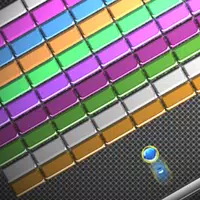
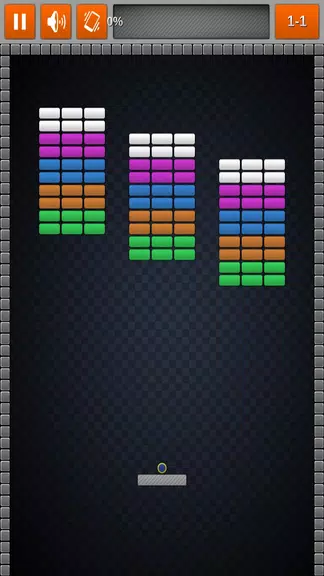
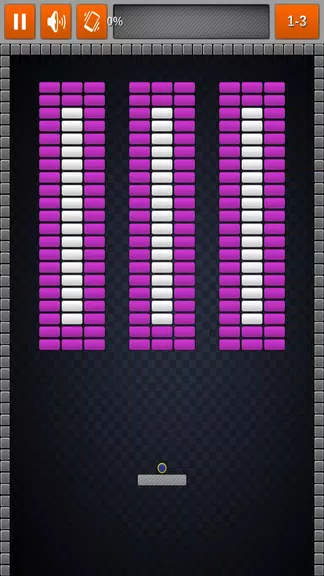

Brick Breaker is a modern take on the classic brick-busting arcade game. Brick Breaker delivers precise touch controls, responsive ball physics and compact stages designed for short sessions or deeper practice. In Brick Breaker you tap to launch the ball, slide to position the paddle and rely on ricochets, timing and occasional power-ups to clear each level while learning layouts and refining aim.
Gameplay and mechanics
Gameplay focuses on predictable yet lively ball movement and level designs that reward angle control and planning. Standard bricks disappear with a single hit while reinforced bricks take multiple contacts; some bricks move or sit at oblique angles to create timing puzzles and encourage angled shots. Hidden and visible power-ups drop from destroyed bricks and temporarily alter gameplay—common effects include slowed or sped ball, multi-ball bursts, paddle expansion and short shields that catch the ball. These elements create short tactical decisions (which power-up to chase) and long-term mechanical depth as later stages blend multiple brick types and moving obstacles that change the rhythm of a run.
Controls and accessibility
Controls are tailored for touch: a single tap launches the ball and a smooth dragging motion moves the paddle across the bottom of the screen. Sensitivity settings let players fine-tune paddle responsiveness for different devices and handedness, including an option to invert movement for left-handed play. Accessibility options include larger paddle and UI modes, color palettes chosen for higher contrast, and on/off toggles for vibration and sound cues so players with varying needs can approach the core challenges without unnecessary barriers.
Progression and level structure
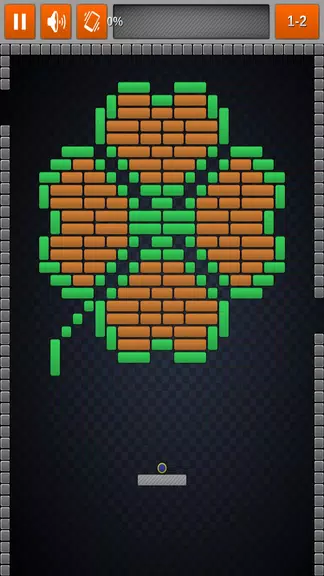
Levels are grouped into themed sets that introduce new brick arrangements, obstacles and timing challenges at a steady pace. Early stages emphasize fundamentals—consistent ricochets and simple angle control—while mid and late sets introduce reinforced bricks, moving columns and tighter formations that demand pattern recognition. Progress is measured by stage completion rather than time limits, which encourages repetition and practice: players can replay difficult sections until mechanics become second nature. Many stages are designed with alternate clear routes, rewarding players who explore ricochet strategies and efficient sequences.
Visual style and audio
The visual approach pairs retro-inspired pixel-forward art with modern clarity: deliberately limited palettes, clear contrast, and clean UI elements help players focus on gameplay while retaining a nostalgic aesthetic. Subtle particle effects and crisp animations emphasize impacts and power-up activations without obscuring the playfield. Audio uses short chiptune motifs and concise sound effects to reinforce hits and state changes; music and sound can be toggled independently so you can play with full audio, stripped-down cues, or silence depending on environment and preference.
Customization and settings
Brick Breaker provides a range of settings so players can match the experience to their device and play style. Control sensitivity and paddle size are adjustable, and display options include larger interface elements and alternate contrast palettes for clearer visibility. Vibration and tactile feedback can be enabled or disabled, and simple performance settings help keep frame rates steady on older hardware. These customization options keep the game accessible without changing the fundamentally skill-based challenge at its core.
Replay value and challenge systems
Replay value comes from improving technique, discovering efficient paths through levels, and finding hidden power-ups. The design favors personal goals—clearing a stage with fewer launches or fewer balls remaining—as a way to increase difficulty without artificial modifiers. Later stages scale challenge through tighter brick formations and mixed brick types that force refined aiming and timing. Because progression is stage-based, players who want extra challenge can revisit earlier levels to perfect lines and shave launches off their best runs.
Offline play and user experience
The game is fully playable offline, making it convenient for travel and situations without reliable connectivity. Menus are streamlined, load times are short, and sessions can start quickly for brief play or longer practice blocks. The interface emphasizes clarity: remaining balls, active modifiers and simple navigation are visible at a glance so the focus stays on play rather than menus. Regular autosave of stage progress avoids losing advancement between sessions.
Limitations
Brick Breaker preserves a classic, mechanically focused arcade experience, which means it may not satisfy players seeking modern 3D visuals or extensive meta-progression systems. Very long sessions can feel repetitive by design, and some later levels require precise touch control and patience to master. Players who enjoy clear, skill-based challenges and steady mechanical progression will find the gameplay familiar, approachable and rewarding as they improve over time.