

Monster Girl Dreams
| Package ID: | |
|---|---|
| Latest Version: | v2581 |
| Latest update: | Aug 05, 2026 09:30:04 |
| Developer: | Threshold |
| Requirements: | Android |
| Category: | Casual |
| Size: | 722.00 MB |
| Tags: | War Drive Management |
Rating :4.4
Monster Girl Dreams is a text-driven, adult-themed battle RPG that puts you in the boots of a newly graduated adventurer exploring a continent populated by monster women. The opening chapters focus on narrative choice, tactical decision-making and character development rather than flashy animation, so the experience is built around reading, stat management and meaningful encounters. This alpha build of Monster Girl Dreams is actively evolving; the developer releases periodic updates aimed at content expansion, balance adjustments and usability improvements.
Gameplay and Combat
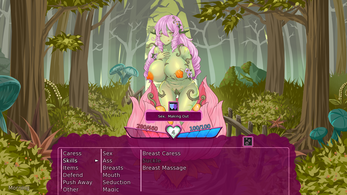
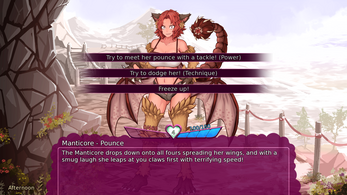
Combat in Monster Girl Dreams is turn-based and menu-driven, emphasizing strategic positioning of stances, resource trade-offs and the interaction of status effects. Instead of conventional attacks, encounters revolve around a curated set of context-sensitive abilities and temptation mechanics resolved through choice menus and numerical comparisons. Each battle plays out as a series of tactical decisions: when to shift stance, which ability to spend limited resources on, and how to respond to opponent-driven pressures that alter resistances or introduce new modifiers. The text-focused presentation encourages careful reading of descriptions and anticipation of enemy tactics rather than reflex-based input.
Character Creation and Customization
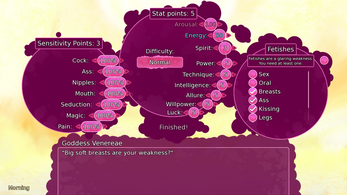
Character creation uses a point-buy system that allows you to shape core stats, resistances and initial tendencies that influence both mechanics and narrative. During setup you select at least one narrative vulnerability or preference that can change how certain opponents interact with you, and these selections have tangible mechanical consequences in some encounters. As you progress you unlock perks and items that support different approaches—bolstering defensive resilience, increasing resistance to particular pressures, or enhancing high-impact affinity moves—so you can reliably pursue multiple viable builds and experiment with varied playstyles.
Progression and Challenge
Progression is driven by experience, perk selection and incremental improvements to your character sheet, with options to specialize as you level. Early stages act as a mechanical tutorial, introducing status management, stance transitions and resource economy, while later chapters combine these systems to create layered encounters that require planning and adaptation. Challenge scales by introducing compounding effects, opponent synergies and situational modifiers rather than simply raising numerical health totals; success depends on reading situations, anticipating sequences and investing in the right long-term improvements.
Controls and User Experience
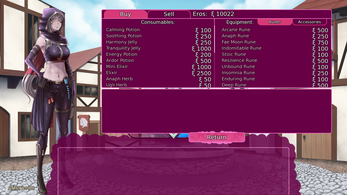
The interface is tailored for touch: actions are chosen through clear menus and dialogue options, and navigation between inventory, character screens and encounter logs is deliberately straightforward. Pacing controls let players move through text at their own speed and review previous choices, which supports a reading-first approach to combat and story. The UI is intentionally minimal to keep the focus on narrative clarity and the tactical decisions presented in each scene, while handy feedback panels summarize relevant stat changes and pending status effects during encounters.
Visual Style and Presentation
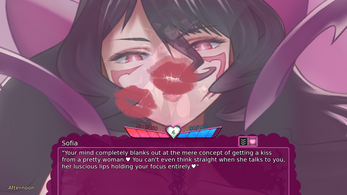
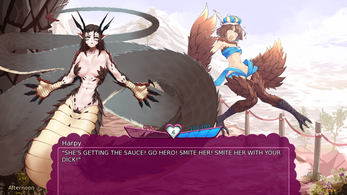
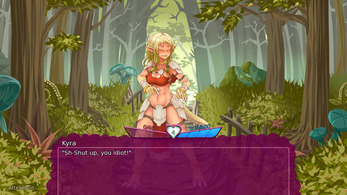
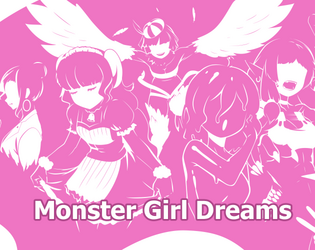
Although predominantly text-based, the game includes illustrated character art and occasional scene panels to reinforce atmosphere and personality without relying on full-motion animation. Art is used sparingly as a narrative accent to highlight character traits and key moments; written descriptions handle most of the scene-setting and consequences. The writing tone balances lighter, whimsical passages with mature thematic material, framing situations to emphasize choice, consequence and character development rather than explicit detail.
Replay Value and Structure
Replayability is built into the system through multiple viable builds, selectable narrative vulnerabilities and branching encounter outcomes. The continental layout groups content into distinct regions and narrative arcs, letting you prioritize exploration, side content or focused advancement in different playthroughs. Different stat allocations and perk selections change not only combat viability but also the way certain scenes unfold, encouraging several pass-throughs to see alternate interactions and strategic permutations.
Accessibility, Offline Play and Development
Because most of the experience is text and menu-driven, the game runs well across a wide range of Android devices with relatively low technical requirements. The alpha status means features like readability options and localization are actively being refined; the developer has noted plans to improve font scaling, color contrast and additional accessibility settings over time. Core gameplay is available offline in the current build, so you can play without persistent connectivity while the developer continues to iterate on content and stability.
What to Expect
Monster Girl Dreams is aimed at mature players who enjoy choice-heavy narratives combined with tactical, menu-based combat. The experience contains adult themes and suggestive situations and is intended for an adult audience; it avoids graphic description while focusing on consequence and player agency. Expect occasional bugs, balance tuning and expanding content in future updates as the project moves beyond alpha. If you appreciate story-rich RPGs with deep customization, layered challenge systems and a reading-first approach to encounters, Monster Girl Dreams offers a distinctive, evolving single-player experience centered on narrative consequence and strategic progression.