21 Solitaire Game blends Blackjack-style decision making with solitaire stacking for fast, strategic runs; in 21 Solitaire Game you place cards on columns, clear stacks that total 21, and manage a limited number of passes to protect your run. The objective in 21 Solitaire Game is straightforward: score as many points as possible before the deck runs out and no legal moves remain, then submit your score to the worldwide table if you choose.
Gameplay overview
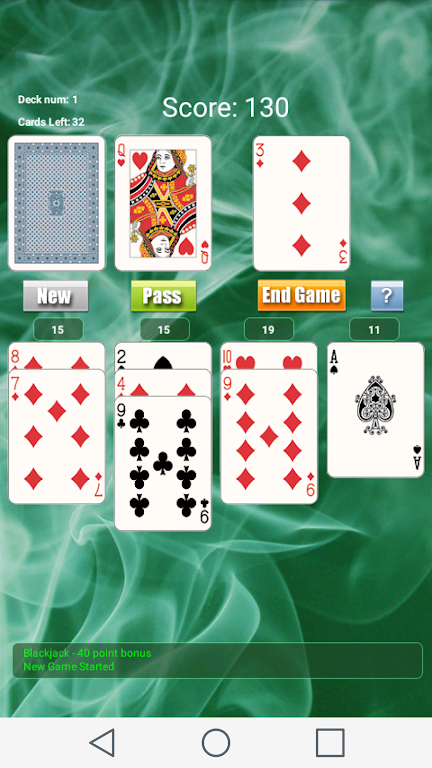
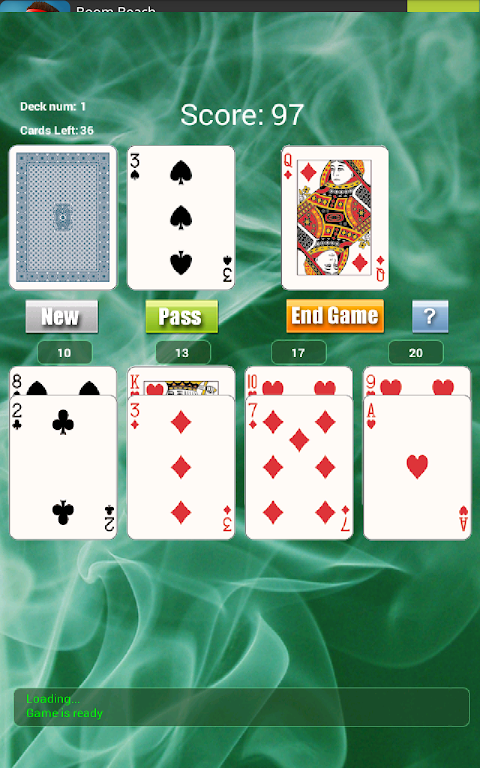
The core loop is simple and immediate. A single dealing card appears and you tap a column to add it to that stack; when the visible stack totals 21 it clears and frees space for more cards. Each deck provides a finite sequence of cards and a maximum of four passes per deck to skip difficult draws. Runs end when there are no legal placements left, so every decision — where to play the current card and when to use a pass — carries weight. Because scoring is based on cleared stacks and efficiency of play, rounds reward thoughtful planning as much as luck.
Controls and user experience
Controls are intentionally minimal: tap a column to place the card, tap the Pass control to advance when you need to avoid a poor placement, and tap New to deal a fresh deck after a run ends. The interface focuses on visibility and quick interaction so that players can make choices without distraction. Visual feedback highlights cleared columns and the current card, helping players scan the table quickly. The game is suited to short, single-handed play sessions as well as longer score-chasing attempts.
Progression, challenge and replay value
Progression in this title is run-based rather than level-based: each deck is a self-contained challenge and the primary measure of advancement is your personal best and standing on the global leaderboard. The limited-pass mechanic and the random shuffle of each deck create a steady stream of fresh situations, and the possibility of abruptly ending a run adds tension that makes successful clears more satisfying. Replay value is high for score chasers who refine placement strategies and risk management over multiple plays.
Visual style and accessibility
The presentation favors clarity over ornate decoration: card faces use large, readable numbers and suits, and columns are laid out with consistent spacing so that the play area remains legible on a range of screen sizes. This clean visual approach keeps attention on decisions rather than elaborate graphics. The straightforward tap controls combined with high-contrast card art make the game approachable for players with varying visual needs and for those who prefer a simple, distraction-free card table.
Offline play and leaderboard
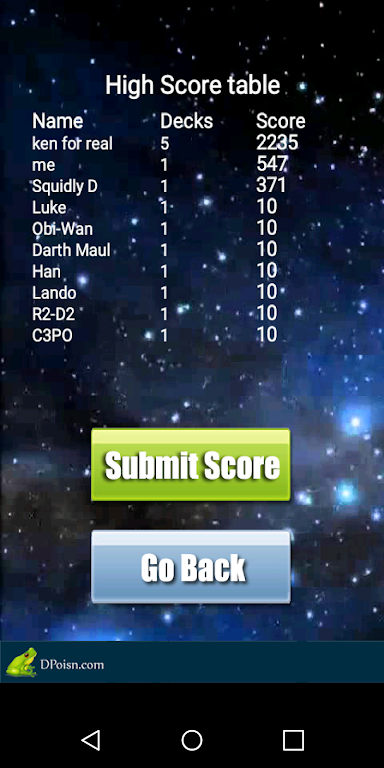
The basic card play is available without a network connection, allowing you to play quick runs while offline; when you are online you may submit scores to the worldwide high score table to compare results with other players. Leaderboard participation is optional, so you can focus on local score improvement or pursue the competitive rankings. Score submission and global ranking provide a simple challenge system for competitive players without introducing real-time multiplayer complexity.
Design philosophy and development
21 Solitaire Game was created by an independent developer who revisited a solitaire-with-blackjack-roots concept from over 20 years ago and refined the scoring and pass mechanics into the current design. The goal was to preserve the plain, tactical feel of classic hand-played card puzzles while improving clarity, pacing, and score-based incentive. The result is a compact card game experience that emphasizes choices, timing, and maximizing each deck.
Who this is for
This game is well suited to players who enjoy short strategic sessions, fans of single-player card puzzles, and anyone who appreciates a lightweight but competitive score-chase. 21 Solitaire Game rewards planning and pattern recognition, and it remains accessible to newcomers thanks to intuitive taps and a forgiving learning curve that still offers depth for experienced players.