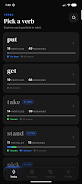


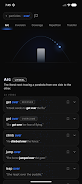



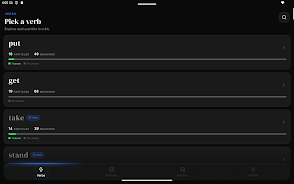

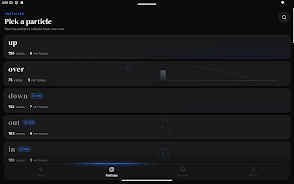

Sink In is a focused learning game that teaches English phrasal verbs by grouping verbs around their particles (up, in, away, off, out, over, on, back…) so meanings click at a structural level rather than as isolated items. It turns practice into short, game-like challenges that use spaced repetition and varied exercise modes to make recall reliable, which is especially useful for intermediate to advanced learners and exam candidates who find phrasal verbs random and hard to retain. If you want a calm, level-based way to internalise dozens of verbs tied to recurring particle meanings, Sink In offers a compact daily routine designed to stick.
Key Features
⭐ Particle-based grouping: verbs are organised by particle so patterns and recurring meanings become visible.
⭐ Spaced-repetition scheduling (SM-2) that spaces reviews to match memory retention.
⭐ Four interleaved exercise modes—recognition cards, particle cloze in context, meaning→particle, and schema match—designed as bite-sized challenges.
⭐ Motion mnemonics and bridge-metaphor sentences anchor each particle meaning to a memorable image.
⭐ Practice tab auto-builds a focused session each day from due items plus a few newcomers.
⭐ Progress rings, streaks, and a profile view let you track advancement through levels of familiarity.
Advantages
✅ Efficient learning: grouping by particle helps dozens of verbs fall into place once a pattern is learned.
✅ Science-backed practice: combines spaced repetition and retrieval practice to improve long-term recall.
✅ Exam-friendly: suitable for B1–C2 learners and candidates preparing for IELTS, Cambridge, or TOEFL.
✅ Clean, calm interface with no ads and local-only progress storage prioritises focus and privacy while using Sink In.
Disadvantages
❎ Narrow focus: the content concentrates on phrasal verbs and does not cover broader grammar or vocabulary topics.
❎ Best suited to intermediate and advanced learners; beginners may find the approach challenging without prior vocabulary base.
❎ The library is described as growing, so some less common or specialized phrasal verbs may be missing initially.